
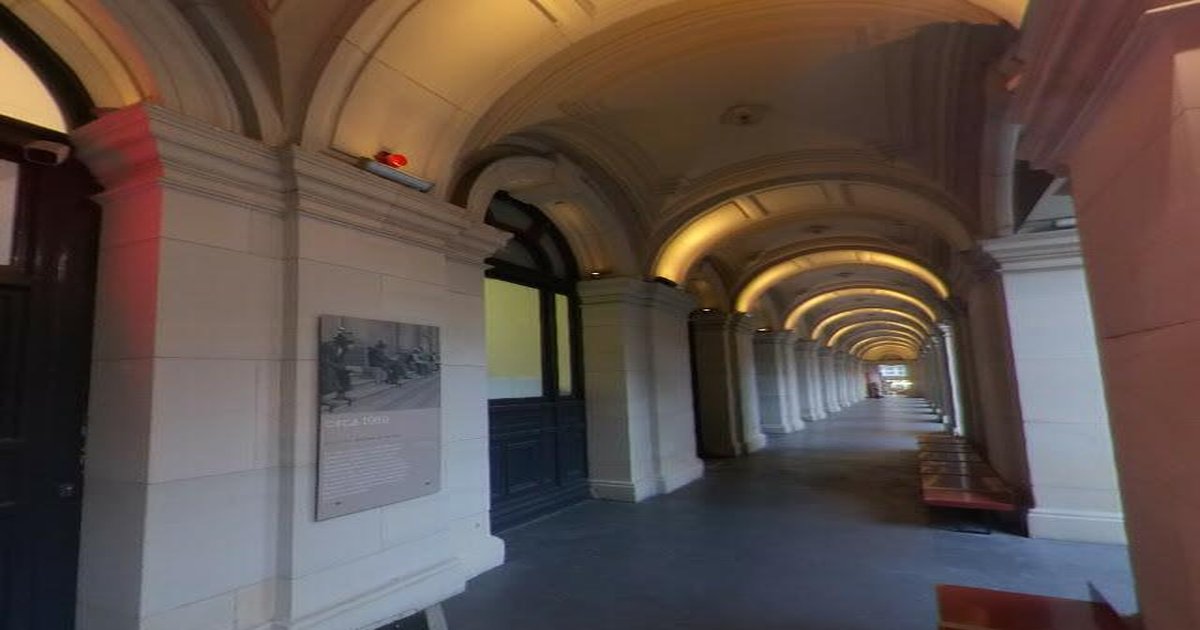
Melbourne CBD’s story starts with a surveyor named Robert Hoddle, who in 1837 laid out the grid of streets that still defines the city today. The Hoddle Grid runs from Spring Street to Spencer Street (now Southern Cross), La Trobe Street to Flinders Street. The wide main streets and narrow service lanes between them were a deliberate design — the main streets for commerce and traffic, the lanes for deliveries and access.
Those service lanes became the laneways that Melbourne is now famous for. It took 150 years, but the city eventually worked out that its back alleys were more interesting than its main streets.
The Gold Rush and the Boom (1850s-1890s)
The Victorian gold rush of the 1850s transformed Melbourne from a small settlement into one of the richest cities in the world. The wealth poured into the CBD’s architecture — the Block Arcade on Collins Street (1891-1893), the Royal Arcade (1869), the Manchester Unity Building (1932), and the elaborate facades along Collins and Bourke Streets all date from this period of extraordinary confidence and capital.
Chinatown on Little Bourke Street was established during the gold rush, making it one of the oldest continuous Chinatowns in the Western world. Chinese migrants who came to the goldfields settled in the CBD, and Little Bourke Street became the centre of Chinese community life, commerce, and dining. It has not moved since.
Flinders Street Station was built between 1905 and 1910, replacing an earlier timber structure. The design by Fawcett and Ashworth won a competition that attracted 17 entries. The distinctive yellow-brick facade and copper dome became Melbourne’s most recognisable landmark. “Meet me under the clocks” became the city’s universal meeting instruction and remains so today.
Federation and the Working City (1901-1960s)
After Federation in 1901, the CBD consolidated as Melbourne’s commercial and administrative centre. The State Library of Victoria on Swanston Street had been open since 1856, but the domed reading room — one of the largest in the world when completed in 1913 — gave the city a public interior that still stops people in their tracks.
Collins Street earned its “Paris End” reputation during this period, with European-style plane trees, high-end retailers, and professional offices clustering east of Russell Street. The western end of Collins Street became the banking and finance district.
Young and Jackson’s pub at the corner of Swanston and Flinders Streets had been serving since 1861, but it was the purchase of the painting “Chloe” in 1908 — a full-length nude portrait now estimated to be worth around $5 million — that gave the pub its most enduring claim to fame.
Post-War Migration and Transformation (1950s-1980s)
Post-war migration from southern Europe, Greece, and Italy brought new communities to Melbourne. Lygon Street in nearby Carlton became Little Italy, while the CBD’s own dining scene began expanding beyond British-Australian pub food. Greek, Italian, and later Vietnamese and Thai restaurants opened in the laneways and side streets.
The 1960s and 1970s brought modernist architecture and demolition of some heritage buildings, but public opposition eventually led to stronger heritage protections. The green ban movement and community activism preserved key buildings that developers had marked for demolition.
The Laneway Renaissance (1990s-2010s)
The transformation that made Melbourne CBD internationally distinctive began in the 1990s. The City of Melbourne adopted laneway activation policies that encouraged small bars, cafes, and galleries to open in the narrow service lanes that had previously been used for rubbish collection and loading docks.
The 1999 Small Bar Licence reform in Victoria allowed venues under 100 capacity to operate without the prohibitively expensive general liquor licence. Bars opened in basements, laneways, and converted warehouses. The Croft Institute, Eau De Vie, and dozens of others followed. The CBD’s laneway bar culture — which tourists now travel internationally to experience — was essentially a regulatory accident that became a cultural identity.
Street art followed the bars. Hosier Lane opposite Federation Square became the most visible example, but AC/DC Lane, Caledonian Lane, and Duckboard Place developed their own artistic identities. Unlike many cities that criminalised street art, Melbourne largely embraced it.
Federation Square opened in 2002 on the site of the old Gas and Fuel Corporation buildings beside Flinders Street Station. The design by Lab Architecture Studio was controversial — the angular, deconstructivist facades divided opinion — but the public space it created became Melbourne’s civic living room.
The Apartment Boom and Modern CBD (2010s-Present)
The 2010s saw a residential apartment boom that fundamentally changed the CBD’s character. Thousands of new apartments went up along Swanston Street, La Trobe Street, and the CBD fringe. The residential population grew from roughly 10,000 in 2000 to an estimated 18,000 to 20,000 by 2026.
The population skews young and diverse — international students from RMIT and the University of Melbourne, young professionals, and a growing cohort of downsizers. The CBD went from a place people worked in during the day and left at night to a genuine residential neighbourhood.
COVID-19 in 2020-2021 tested the CBD harder than any event since the gold rush bust. Office occupancy collapsed, foot traffic vanished, and dozens of restaurants and bars closed permanently. The recovery has been uneven — by 2026, office occupancy sits at roughly 60 to 70 percent of pre-pandemic levels, but the dining, bar, and cultural scenes have largely rebuilt, in some cases stronger than before.
FAQ
How old is Melbourne’s Chinatown? Little Bourke Street’s Chinatown dates to the 1850s gold rush, making it one of the oldest continuous Chinatowns in the Western world.
When was Flinders Street Station built? Between 1905 and 1910. The design won a competition in 1899. It handles roughly 90,000 passenger movements per day on weekdays.
What is the oldest building in the CBD? The Mitre Tavern on Bank Place dates to 1837, making it the oldest surviving structure in Melbourne. It has operated as a pub since 1868.
The Verdict
Melbourne CBD’s history is a story of reinvention. From colonial survey grid to gold rush boomtown, from post-war migration hub to laneway capital. The Hoddle Grid has not changed, but everything built on top of it has transformed multiple times. The laneways that were designed as rubbish collection routes became the city’s defining feature. That kind of accidental brilliance is hard to replicate, and it is the reason Melbourne CBD feels different from every other Australian city centre.
More on Melbourne CBD: The Complete Suburb Guide | The Honest Guide | Best Restaurants
Explore More of Melbourne CBD
- Melbourne CBD Cocktails
- Melbourne CBD Melbourne Cbd For Retirees
- Melbourne CBD Cheap Eats
- Melbourne CBD Cheap Eats V2
- Melbourne CBD Rent Guide
- Melbourne CBD Best Restaurants V2
- Melbourne CBD Weekend Guide V2
- Melbourne CBD New To Cbd
💬 Discussion
Join the conversation — no account needed